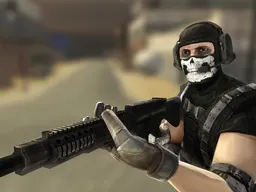
Survivalist
Survivalist is a free browser-based shooting game that runs on desktop and mobile where you command a squad of three survivors down an endless lane, holding fire on gates to rack up multipliers while choosing between risky rewards and deadly traps, breaking crates for power-ups, and facing increasingly dangerous bosses.
Your First Minutes
You start with three squad members standing in a vertical lane. Enemies and obstacles come down toward you, and your job is to shoot them before they reach your position. The screen shows your squad at the bottom, a clear path in the middle, and waves of threats descending from above. Your first instinct is to hold down fire and blast everything, but that's where the game teaches you its real hook: gates. When you see a gate marked with a plus sign, holding fire makes the number grow—a +1 can climb to +20 if you're patient enough. The tension starts immediately because while you're focused on one gate, other threats are moving closer. You'll notice green and blue crates scattered throughout the lane. Breaking a green crate boosts your damage output; a blue one speeds up your fire rate. Both feel good to grab, but both also pull your attention away from what's actually dangerous. That first stage ends with a boss—a bigger, slower target that requires sustained fire to take down. When it kills you, which it probably will, the stage restarts but the boss comes back noticeably weaker.
Main Mechanic
The core loop revolves around gate selection and meter management. Gates always appear in pairs with a lethal pillar between them, forcing you to commit to one side or the other. One gate offers multiplication—times three means whatever points or resources you've built multiply immediately, but the reward is often small to start. The other gate offers addition—plus eighteen sounds huge until you realize it doesn't scale with your effort the same way. Then there's the trap: the divide by five gate, which you must actively avoid. Holding fire on a gate is a risk-versus-reward calculation. The longer you shoot, the higher the number climbs, but enemies keep advancing. Release too early and you waste the gate's potential. Hold too long and something reaches your squad. Between gates are standard enemies that die quickly with basic fire. The survival element comes from constant movement and positioning. Your squad can dodge left or right—anything solid that touches you costs health. When you break a green crate, your next shots hit harder for a period of time. When you grab blue, your fire rate jumps noticeably. These power-ups matter, but they're scattered randomly, so you can't rely on them. Each stage is a gauntlet of gates, decisions, and dodging, culminating in a boss encounter. Bosses don't follow the gate system; they're pure shooting tests that require pattern recognition and sustained damage output. Die at any point and you restart the stage, but the game gives you a permanent advantage on that boss's next appearance—it has less health, moves slower, or both.
Controls
Desktop: Use your mouse to move your squad left and right across the bottom of the screen. Press and hold the left mouse button to fire at whatever is in front of you. There's no reload mechanic—fire is instant and continuous. Mobile: Tap and drag your finger left or right to reposition your squad. Tap and hold anywhere on the screen to shoot. The controls are deliberately simple because the challenge isn't execution; it's decision-making. You're never fighting the input system, just the constant stream of choices: which gate, when to shoot, when to dodge, whether to chase a crate or focus on staying alive.
Mistakes Everyone Makes
The biggest trap is gate greed. A plus eighteen looks incredible compared to a times three, so new players always pick the addition gate. In the early stages, this works fine because your multiplier is low anyway. But the gate mechanic is designed so that times three compounds over time—if you grab a times three when your modifier is already at plus fifteen from previous gates, you suddenly have plus forty-five. The plus eighteen gates are better for resetting and banking points, but they're not the path to high scores. Second mistake: ignoring power-ups. You see a crate and think it's optional flavor, so you focus entirely on gates. In reality, a green crate at the right moment can let you burst through a boss phase that would otherwise kill you. Blue crates turn your fire rate into a minigun, and that changes which gates you can safely maximize. Third mistake: staying in one lane too long. The temptation is to pick a side and commit, but the lane is only so wide, and sometimes dodging requires you to reverse course. New players hesitate to move, thinking it breaks their aim. It doesn't—your fire follows your position automatically. The final common error is panicking during bosses. After a stage of gates and power-ups, the boss appears and plays by different rules. There's no multiplication, no crates, just you versus a heavy target. Players often waste ammo spraying wildly instead of settling into a rhythm and watching the boss's pattern.
When Difficulty Ramps Up
The early stages ease you in with slow enemies and forgiving gate timers. Around the third or fourth stage, the lane gets busier. Multiple waves overlap, meaning you're dodging while deciding on a gate while tracking a crate while a boss is approaching. The game stops waiting for you to make perfect decisions. Bosses themselves become the real difficulty wall. The first few bosses have obvious attack patterns and slow movement. Later bosses move faster, attack in clusters, and take significantly more punishment to defeat. You'll hit a stage where you're winning most of the non-boss portion but consistently dying on the boss fight. This is the moment many players quit, thinking they've hit a skill ceiling. In reality, the game is nudging you to optimize your power-ups. If you're not collecting enough green and blue crates in the stages leading up to a boss, you're walking into that fight without your best tools. The gate multipliers matter here too—a well-stacked times three modifier going into a boss phase can be the difference between a two-minute fight and a thirty-second one.
How to Actually Improve
First, treat gates as investments, not instant rewards. The plus eighteen feels satisfying immediately, but a times three when your current modifier is already high is better long-term. Learn to recognize which gate to pick based on where you are in the stage, not just which number is larger. Second, develop a mental map of your squad's position. The lane isn't infinitely wide, but it's wide enough that you rarely need to panic-dodge. Smooth, deliberate movements beat frantic button mashing. Third, actively hunt power-ups in early stages. If you see a green or blue crate, it's worth repositioning for, especially if the lane is temporarily clear of threats. Fourth, watch boss patterns instead of just firing constantly. Every boss has a rhythm to its attacks. Learning that rhythm means you can predict when to dodge and when you're safe to focus entirely on damage output. Finally, accept that deaths on bosses are learning experiences. Each time you die, that boss gets easier next run. You're not stuck—the game is designed so that persistence on a single boss gradually wears it down. Come back to a stage three times, and that boss will fall.
What to Expect After an Hour
After an hour of play, you'll have cycled through several stages and encountered bosses multiple times. The early bosses are now dead consistently. You've probably hit a new wall—a stage where either the regular enemies are overwhelming or the mid-stage boss is tougher than anything you've faced. You understand the core loop so well that it feels automatic; what challenges you now is decision-making under pressure, not mechanical confusion. You've developed preferences: maybe you love times three gates and chase them aggressively, or maybe you prefer the safety of plus eighteen rewards. The game starts revealing that there's depth to gate selection based on stage position and current modifiers. You've also learned which power-ups matter most to you. Some players prioritize green crates and go all-in on burst damage for bosses; others focus on blue for sustained fire. This specialization is the marker that you've moved past the tutorial phase into actual strategy. The difficulty curve means you won't complete the game in an hour, but you'll have unlocked enough understanding to feel like you're making meaningful progress. Deaths still happen, but they sting less because you understand why they happened and what you'll do differently next time.
Controls
Keyboard and mouse
- Move mouse left and right to position your squad
- Press and hold left mouse button to fire continuously
Touch
- Tap and drag your finger left or right to move your squad
- Tap and hold on the screen to fire continuously
FAQ
- Is Survivalist free to play?
- Yes, Survivalist is completely free to play in your browser. No download required, no account needed.
- Does it work on my phone?
- Yes, Survivalist runs on mobile browsers just like it does on desktop. The controls adapt to touch—you tap and drag to move your squad and tap-hold to shoot.
- What does holding fire on a gate actually do?
- When you aim at a gate and hold fire, the number on that gate increases over time. A plus one can climb to plus twenty if you keep shooting. The longer you hold, the higher it goes, but enemies keep advancing, so you have to balance risk versus reward.
- Why should I pick the times three gate instead of plus eighteen?
- Times three multiplies your current score modifier, which compounds over time. If your modifier is already high, times three gives you a bigger boost than plus eighteen. Plus eighteen is good for resetting and stabilizing, but times three scales better through a stage.
- What happens when I die?
- You restart that stage, but the boss you were fighting becomes permanently weaker—it has less health or slower movement on your next attempt. Eventually, through repeated attempts, you'll wear it down enough to win.
- Do the green and blue crates respawn in the same place?
- Crate placement is randomized each run, so you can't memorize their locations. The strategy is recognizing when a crate appears and deciding whether it's worth repositioning to grab it or better to stay focused on your current threats.
- Is there a time limit on stages?
- No time limit. The pressure comes from enemies and obstacles advancing down the lane. Take as long as you need, but threats keep coming the entire time.
Similar games
More Shooting Games games →