Play Football
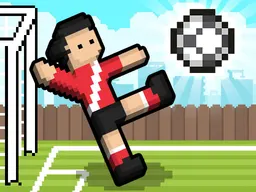
Play Football is a free soccer skill game you can play right now in your web browser on desktop or mobile, where you control the angle and power of your shots to thread the ball through defenders' legs while the game gets progressively faster.
The First Minutes
When you start Play Football, you're looking at a simple soccer setup: a player ready to shoot, and your job is to figure out the exact angle to make the ball slip through an opponent's legs without hitting them. The game doesn't throw much at you right away. You'll click or tap to aim your shot, watching as you position the angle of the kick. Once you release, the ball travels across the field toward your target. If you thread it cleanly between the legs, you move to the next attempt. The early rounds are forgiving enough to let you understand what you're doing. You'll notice pretty quickly that precision matters way more than power here. The screen is clear, the target is obvious, and there's no timer screaming at you in those first few tries. It's just you, the ball, and the gap you need to hit.
Main Mechanics
The core of Play Football revolves around one repeated action: positioning your shot angle and executing it. You're essentially solving a geometry problem over and over. Each round presents you with a defender or obstacle, and you need to calculate the angle that will make your ball pass between their legs rather than collide with their body. Miss the angle, and you fail the attempt. Get it right, and you advance. What makes this interesting is that the game doesn't stay static. As you progress through rounds, the speed of the game increases. This doesn't mean the ball moves faster, but rather the game demands more from you more quickly. The margins for error shrink. An angle that would have worked earlier might not work anymore because timing becomes tighter. The game is built around this escalation of difficulty, so the skill progression isn't about learning new rules but about refining your ability to judge angles under increasing pressure. There's no special power-ups, no multiple game modes mentioned in the base version. It's pure, focused challenge: can you read the geometry and execute consistently as things speed up?
Controls
Play Football uses a straightforward control scheme that works the same whether you're on a computer or a phone. On desktop, you use your mouse to interact with the game. You click to aim your shot, adjusting the angle of the kick by moving the mouse or clicking at different positions. Once you've set your desired angle, you click again or release to execute the shot and send the ball toward the target. On mobile devices, you tap the screen instead of clicking. The tap-based controls work identically to the mouse version. You tap to aim, adjust your angle by tapping or holding at the position you want, then tap again to shoot. The game is designed to be fully playable on touchscreen, which is why it runs well on phones and tablets. Neither version requires you to memorize complex button combinations. Everything is direct: you see where you want the ball to go, you position that angle, and you execute. The simplicity of the controls means the difficulty comes entirely from the challenge of reading the angle correctly, not from fighting clunky mechanics.
Mistakes Everyone Makes
The most common mistake when starting Play Football is overthinking the angle. Players often second-guess themselves, trying to aim for the absolute center of the gap between the legs rather than anywhere within the safe zone. In reality, you have more room than you think. The gap is bigger than your brain initially tells you. New players also tend to rush their shots. Because the game escalates speed quickly, there's a temptation to hurry. But rushing leads to sloppy angle judgment, which is where you actually lose. Taking a breath and committing to your angle choice, even if you're wrong, teaches you faster than hesitating. Another frequent error is not adjusting to the speed changes. When the game speeds up, players often stick with the same deliberate pace they used in early rounds. By the time things are moving fast, you need to be faster too, but not careless. The rhythm of your decision-making has to match the rhythm of the game. Finally, people sometimes blame the controls when the real issue is their own inconsistency. The controls are responsive and simple. If you're missing shots that you hit before, it's usually because the angle requirements have shifted with the increased difficulty, not because your mouse or tap input is suddenly broken.
When It Gets Hard
Play Football's difficulty curve is built into its core mechanic: the speed increases as you survive more rounds. In the early stage, you might comfortably hit five or six shots in a row. Then the game picks up the pace. The fifth round onward is where most casual players start to feel real pressure. Angles that were easy to read suddenly feel tighter. The game isn't giving you longer to decide. You're making snap judgments now instead of careful calculations. This is when the game stops being relaxing and starts being a test of your reaction time and spatial intuition. The hard part isn't a sudden rule change or a new obstacle type. It's the same mechanic, but faster and more punishing. One missed angle and you're done. There's no second chance, no recovery phase. You either keep up with the escalating speed or you fall. The psychological challenge kicks in around this point too. You know the next round will be even harder, so you're putting pressure on yourself to maintain your streak. That pressure sometimes makes you play worse, not better.
How to Actually Get Better
The path to improving at Play Football is straightforward but requires patience. First, stop trying to win forever. Instead, focus on consistency over three or four rounds. Get comfortable with the basic angle judgment before worrying about the speed increase. Play enough times to internalize what a correct angle looks like. Your brain should start recognizing the geometry without conscious calculation. Second, pay attention to your failures. When you miss a shot, look at where the ball went. Did it clip the defender's leg? Did you undershoot? Overshoot? That feedback loop is everything. The game is teaching you through failure if you're paying attention. Third, develop a rhythm. Don't rush your aim, but don't deliberate forever either. Find a pace that lets you be confident in your angle choice while still acting decisively. Speed comes from confidence, not from moving faster. Fourth, embrace the escalation. The game wants you to handle higher speeds. Play enough to get to those harder rounds regularly. You'll adapt faster than you think. Finally, don't compare your streaks to anyone else's. What matters is whether you're hitting more shots this session than last session, whether you're surviving to higher speeds, whether the angles are becoming more intuitive. That's the only progress that counts.
What to Expect After an Hour
If you've played Play Football for about an hour, you'll have noticed a few things. The early rounds feel trivially easy now. You can hit those first few shots without thinking much about it. The jump to higher speeds still hurts, but you're reaching it more consistently than you did at the start. You're probably comfortable enough to play multiple sessions without getting frustrated by the basic mechanic. You understand the geometry well enough to make quick reads. You've also learned your personal limit. You know around which round the game stops feeling like fun and starts feeling like unfair pressure, and that round differs for each player. An hour is enough time to know if this game is for you. If you enjoy the simplicity of the challenge and want to gradually improve your reaction time and angle judgment, you'll keep coming back. If you find the escalation frustrating or the one-shot-and-you're-done mechanic too punishing, you'll probably move on. There's no plot to discover, no unlock system to chase. Play Football is entirely about your own skill progression against the clock. After an hour, you've seen the core loop. Everything else is repetition and incremental improvement.
Controls
Keyboard and mouse
- Click to aim and adjust the angle of your shot
- Click again or release to execute the shot
- Mouse movement helps position the angle before you shoot
Touch
- Tap to aim and position the angle
- Tap again to execute and shoot the ball
- Use your finger to adjust the angle before releasing
FAQ
- Do I need to download anything to play?
- No. Play Football runs directly in your web browser, whether on desktop or mobile. Just open the game and start playing right away. No installation, no downloads required.
- What exactly do I need to do to win a round?
- You need to position your shot at the correct angle so the ball passes between an opponent's legs without hitting them. Once you've set the angle, you click or tap to shoot. Get it through, and you move to the next round. Miss, and the game ends.
- Does the game have different difficulty levels I can choose?
- The game doesn't have selectable difficulty levels. Instead, it automatically increases the speed and challenge as you progress through rounds. The difficulty ramps up naturally the longer you survive.
- How many rounds can you actually get through before it becomes impossible?
- That depends entirely on your skill and reaction time. The game will keep escalating speed indefinitely, so there's no hard cap. Most players hit a wall where they can't keep up anymore, but that wall is different for everyone.
- Is there a timer, or can I take as long as I want to aim my shot?
- There's no strict timer forcing you to hurry, but the game's speed increases the longer you play. In later rounds, you're expected to make decisions faster because the overall pace of the game has ramped up.
- Can I play this on my phone?
- Yes, absolutely. Play Football works on any mobile device with a web browser. The touchscreen controls are fully functional, and the game is optimized for smaller screens.
- What happens if I miss? Do I get another try, or is it game over?
- One miss and the game is over. There are no extra lives, no second chances per round. This is part of what makes the game intense once the speed increases.
Similar games
More Sports Games games →