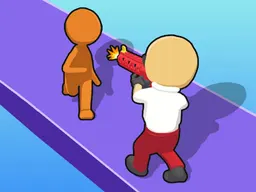
Hide 'N Seek!
Hide 'N Seek! is a free 3D arcade game you play right in your browser on any device, including mobile phones, where you either run and hide in a maze while collecting diamonds or hunt down other players in the dark—whichever role the game assigns you each round.
The Game's Core Idea
Hide 'N Seek! splits its gameplay between two distinct roles that flip on their head depending on the round. In one mode, you're the fugitive trapped inside a maze with other players, racing against a countdown timer while grabbing diamonds scattered throughout the level. Your job is simple: survive long enough and rack up points before time runs out. In the opposite mode, you become the hunter, but here's the catch—you're working almost blind. The players hiding from you are invisible on your screen, and you can't see them clearly. You have to rely on instinct, sound cues, or pure luck to track them down before they escape. The game plays with the tension between visibility and invisibility, between knowing exactly where you are and having no idea where your opponents lurk. This back-and-forth between hunter and hunted creates an unpredictable arcade experience where your role changes but the stakes stay high. The 3D maze keeps both modes interesting because sightlines matter; you can duck around corners, hide behind walls, or sprint down long corridors depending on which side you're on. Diamonds act as your reward system when you're running, giving you incentive to take calculated risks instead of just hiding in one spot.
How You Play
Each round of Hide 'N Seek! assigns you a role at random, and the game mode changes everything about your strategy. When you're the runner, you spawn into a three-dimensional maze alongside other players in the same situation. A timer ticks down in the corner—you have a limited window to stay alive and gather diamonds. These aren't randomly scattered; they sit at specific locations throughout the maze, which means you quickly learn that speed and memory become as important as caution. Running straight to every diamond gets you killed; instead, you learn routes that let you grab clusters without exposing yourself to the hunters' paths. The hunters are already in the maze too, patrolling or standing still, waiting to catch runners who pass nearby. When the timer expires or all runners are caught, the roles reverse. Now you're the one hunting. This is where it gets strange: your screen doesn't show the hiding players clearly. You know they're in the maze somewhere, but pinpointing them requires listening for audio clues, watching for movement out of the corner of the screen, or methodically checking hiding spots you'd use yourself. Some hunters patrol aggressively; others camp chokepoints. The game doesn't hold your hand about strategy—you figure out through repetition what works and what leaves you empty-handed. Newer players often sprint around frantically when hunting and get caught easily when running because they don't realize which routes the hunters favor. Once you've played ten rounds, you start recognizing patterns in how the maze funnels movement and where diamonds cluster, and that's when you stop being prey and start being a threat.
Controls
On desktop, you control your movement using the arrow keys or WASD to navigate through the maze in any direction. Your character responds immediately, so precision matters when you're weaving between walls or trying to outrun a hunter. On mobile devices, the game uses slide controls—you swipe across the screen to indicate the direction you want to move. Swiping up sends you forward, swiping down reverses you, and swiping left or right rotates your character. The swiping system works surprisingly well for a maze game because it's continuous rather than tap-based; you can hold a swipe to keep moving in one direction, which is crucial when you're in full sprint mode to escape. The mobile version scales to fit smaller screens while keeping the 3D perspective readable, so whether you're on a phone or tablet, the controls stay responsive. There's no jump button or special action—all gameplay flows from pure movement through the environment, which keeps the control scheme straightforward but demands timing and spatial awareness to use effectively.
Strategies That Work
When you're running and gathering diamonds, never run in a straight line toward the nearest one if you haven't seen where the hunters are positioned. A hunter camping near a diamond cluster will catch anyone greedy enough to barrel straight in. Instead, scout the area first—move near the wall, peek around corners, and only commit to grabbing diamonds when you've confirmed no one's lurking. The maze has multiple routes between points; learn them so you can change direction fast if you hear a hunter approaching. Timing matters too: early in the round, hunters are still figuring out where to position themselves, so the first few seconds offer the best window to grab high-value diamond locations. As the timer winds down, most runners are caught, which means fewer targets for hunters to chase—but also fewer competitors for remaining diamonds. Switching to hunter mode requires completely different thinking. You can't see your targets, so you hunt by process of elimination and sound. Camp near the diamond locations because runners need them to win; just standing near a high-value cluster will eventually catch someone. If you hear movement but can't pinpoint it, don't charge blindly—instead, listen for the pattern. Runners tend to sprint in bursts to new locations, so quiet your own movement and let them come to you. Hunt near maze junctions because players funnel through these points. The hunters who catch the most players aren't the fastest runners; they're the ones who understand traffic patterns and wait where prey naturally congregates.
What Separates Good Players
Excellent players at Hide 'N Seek! develop a kind of maze memory that novices lack. After a few rounds, they know the maze layout well enough to navigate it without thinking, which frees up mental energy for actual gameplay—watching for threats, planning routes, listening for audio cues. A new player gets lost or takes wrong turns; a seasoned one is already three corridors ahead planning their next move. When running, good players understand risk versus reward. They don't grab every diamond in sight; they identify the safest clusters and commit to those, ignoring risky pickups in exposed areas. They also use the maze's geometry strategically, moving along walls and around corners where sightlines are blocked, rather than sprinting down open hallways. When hunting, the skill gap widens dramatically. Mediocre hunters patrol randomly and react to sounds; skilled hunters predict where runners will go based on diamond locations and maze structure. They camp intelligently instead of moving constantly, because movement gives away their position. The best hunters also understand that runners get more desperate as the timer winds down, pushing into riskier territory for final pickups—so they tighten their patrols near high-value areas as the clock ticks lower. These players also recognize other hunters' positions and coordinate implicitly, blocking exit routes and funneling runners into ambushes. Game sense—knowing where people are without seeing them, anticipating panicked decisions, understanding the rhythm of each role—separates someone who plays Hide 'N Seek! from someone who masters it.
Game Modes and Variations
Hide 'N Seek! centers on a single core loop with two roles that alternate: runner and hunter. Within each round, the conditions stay consistent, but the game doesn't force progression through levels in the traditional sense. Instead, variety comes from how the maze itself changes your tactics based on your assigned role. The runner mode stays mechanically the same—collect diamonds, avoid hunters, beat the timer—but the real variation emerges from different players' approaches. Some games you'll face hunters who camp aggressively; others you'll face passive ones who barely move. The diamonds stay in the same spots, so you learn optimal collection paths, but the presence of other runners competing for the same diamonds adds unpredictability. The hunter mode is where true variation lives because the core mechanic is so different. You're working with severely limited information, which means no two rounds feel identical. One match you might catch someone immediately; another you might never spot a runner at all. The game doesn't introduce new mechanics or special items as you progress—it's a pure, simple concept that relies on player skill and decision-making to generate depth. As you play more rounds, the game's appeal shifts from learning what to do to mastering how to do it better than everyone else in the maze.
Similar Games You Might Enjoy
If Hide 'N Seek! clicked for you, look for other asymmetrical multiplayer games where teams have different objectives. Games like Among Us share the core tension of hidden identity and deduction—you're either hunting or hiding, trying to figure out who's who and what their role is. The pacing is slower and more social, but the mind-game element is similar. For pure maze navigation with a time crunch, Pac-Man arcade games offer that same chase dynamic where you're either running or chasing, though without the multiplayer element. If you want 3D maze gameplay with modern graphics, look for first-person or third-person maze runners that emphasize navigating tight spaces while avoiding obstacles. Games focusing on quick reflexes and pattern recognition in arcade settings—like Flappy Bird descendants or rhythm-based dodgers—share Hide 'N Seek!'s demand for timing and spatial awareness. The unique blend of hide-and-seek mechanics mixed with 3D navigation and role-swapping is less common, which is partly why Hide 'N Seek! stands out. Most games let you control your role; this one forces you to adapt to whatever the game assigns you, which is refreshing for arcade players tired of games that let them stick to one strategy all session.
Controls
Keyboard and mouse
- Arrow Keys or WASD to move through the maze in any direction
- Hold a key to continue moving in that direction
- No special actions or buttons—movement is your only control
Touch
- Swipe up to move forward
- Swipe down to move backward
- Swipe left or right to rotate and turn
- Hold a swipe to keep moving continuously in that direction
- Works on phones and tablets with touch screens
FAQ
- Is Hide 'N Seek! really free, and do I need to download it?
- Yes, it's completely free and plays directly in your web browser—no download, no installation, no hidden costs. You can start playing immediately on any device that has a browser.
- How do I know if I'm going to be a runner or a hunter in a round?
- The game assigns your role randomly at the start of each round. You don't choose; you either spawn as a runner in the maze collecting diamonds or as a hunter trying to find the runners. This random assignment is part of what keeps the game fresh—you have to be skilled at both roles to consistently win.
- Why can't hunters see the runners they're looking for?
- That's the core mechanic of the hunting role. Runners are hidden from your view, forcing you to rely on sound cues, audio feedback, logic about where runners need to be, and sometimes pure luck. It's meant to be challenging and creates tension—hunting blind is harder than hunting with full vision, but it's also more rewarding when you do catch someone.
- What's the best strategy when I'm running out of time and there are still hunters everywhere?
- Don't panic and sprint blindly. If the timer is nearly gone, focus on staying alive rather than grabbing every remaining diamond. Hide in corners, move cautiously between safe zones, and remember that hunters can't see you clearly. Many runners get caught in the final seconds because they rush for diamonds they don't need. Survival counts as a win.
- Do the levels get harder the more I play, or is it always the same?
- The game doesn't have traditional levels with increasing difficulty. Instead, the maze stays consistent, but your competition gets tougher as you play against the same players repeatedly. You'll learn the maze layout and optimize your strategy, but there isn't a progression system with new stages. The challenge comes from outplaying other humans, not from new obstacles or mechanics.
- Can I play Hide 'N Seek! on my phone, or is it only for computers?
- It works on both. The game is responsive and scales to mobile screens. On phones and tablets, you control movement by swiping instead of using keyboard arrow keys, so the experience adapts to your device.
- How many people can play in one game?
- The game has multiple players in each maze—multiple runners and multiple hunters—though the exact number per round isn't specified in the available information. It's always multiplayer, so you're never alone in the maze.
- What happens if I get caught as a runner? Do I have to wait until the round ends?
- Once a hunter catches you, you're out for that round. Yes, you wait for the timer to expire or for all remaining runners to be caught before the next round starts, which resets roles. It's quick between rounds, so downtime is minimal.
Similar games
More Arcade Games games →